


If you are a marketer looking for a production house, your brief can make or break the project before the first meeting.
A good brief does not need to tell the video team exactly what to shoot. It should give them the strategic context they need to recommend the right creative direction, budget, timeline, and deliverables.
A video production brief should include the project background, business objective, target audience, key message, desired action, distribution channels, deliverables, timeline, budget range, brand guidelines, reference videos, locations, talent requirements, mandatories, approval process, and main point of contact. The clearer the brief, the easier it is for a production house to propose the right concept and scope.
This article is for marketers, brand managers, campaign leads, founders, and business teams preparing to brief a video team or production house.
It is especially useful if you know you need a video but want to give the production team enough context to recommend the right creative direction, scope, timeline, and deliverables.
A video brief matters because it gives the production team the context behind the video. Without it, the team may understand what you want to film but not why the video needs to exist. Emergent’s guide to engaging a video agency also explains why sharing the full vision early helps the agency shape stronger ideas.
Adobe describes a creative brief as a document that defines the scope and goals of a project while giving creative teams a roadmap for alignment (Adobe Business). Ziflow also notes that a video production brief defines the project goals and explains how the video asset will fulfil them (Ziflow).
For marketers, this is especially important because your video is usually tied to a campaign, launch, sales funnel, or brand objective. A production house can bring the creative craft, but they need your strategic inputs to make the video useful.
A marketer should include enough information for the production team to understand the goal, audience, message, constraints, channels, and success criteria of the video.
Explain the business objective by stating the job the video must do. Avoid vague goals like “make us look good” or “create awareness” unless you define what success looks like.
Inbound Video Marketing recommends avoiding fuzzy objectives and focusing instead on measurable behaviour changes (Inbound Video Marketing). This is useful advice for marketers because a production house needs to know whether the video is meant to drive trust, traffic, leads, sales, sign-ups, internal alignment, or recruitment.
The more specific the objective, the easier it is to decide the concept, length, filming style, and call-to-action.
Describe the target audience as real people with specific needs, not a broad demographic category. The production team needs to understand who the viewer is, what they care about, and what might stop them from taking action.
For example, “business owners aged 30-50” is not enough. A stronger audience description would be: “Marketing managers at regional consumer brands who need a reliable production partner for campaign videos but are worried about unclear pricing, slow timelines, and creative misalignment.”
This level of detail helps the production team make better creative decisions. The video can then speak to a real audience instead of a vague market.
Give the video team one main message, supported by proof points. A single video can include several details, but it should not try to communicate five different strategic ideas at once.
The production house can help turn your message into a story. Your job is to clarify what the audience should remember.
If there are too many messages, consider producing a video series instead of forcing everything into one master video.
List every final asset you expect to receive, including length, orientation, format, subtitles, language versions, and usage. This helps the production house estimate cost and plan the shoot correctly.
Keyy Productions recommends defining actual quantities and types of finished videos, including orientation and duration, so the video team understands the expected outputs from the start (Keyy Productions).
Do not assume these are automatically included. Ask the production house what is included in the quote and what counts as an additional edit.
Share exactly where the video will be used because every platform has different requirements. A homepage hero video, LinkedIn post, Instagram Reel, YouTube ad, and event screen may all need different framing and pacing. This is also where a clear video marketing strategy helps the production team plan the right versions from the start.
Ziflow notes that video briefs often need details specific to video production, such as storyline, visual style, tone of voice, and file formats (Ziflow). For marketers, this means channel planning should not be left until the final export.
If you need both horizontal and vertical versions, mention it early. The production team can frame the shots with enough space for different crops.
Yes, include at least a budget range. Budget helps the production team recommend a realistic concept instead of developing ideas that are too simple or too expensive for the project.
Lambda Films recommends sharing an estimated budget range because it helps the production agency understand the project’s scope and propose ideas that fit the financial expectations (Lambda Films).
Budget affects:
If you are unsure of the budget, be honest. A good production house can usually explain what is possible at different investment levels.
Include reference videos that show the style, tone, pacing, lighting, framing, editing, or storytelling direction you like. Also include examples you do not like if they help clarify the direction.
References should not be treated as videos to copy. They are visual shorthand. A marketer may say “premium but approachable”, but a reference video can show what that actually means in terms of lighting, music, editing, and pacing.
This helps the production team understand taste, not just requirements.
Clarify who reviews the concept, script, storyboard, first cut, final cut, and final exports. The approval process is one of the biggest sources of delay in video production.
Inbound Video Marketing notes that the approval process affects timeline planning and that one central point of contact helps collect feedback and avoid conflicting comments (Inbound Video Marketing).
One person should own feedback collection. Otherwise, the production team may receive conflicting notes from multiple stakeholders.
Use this template before contacting a production house.
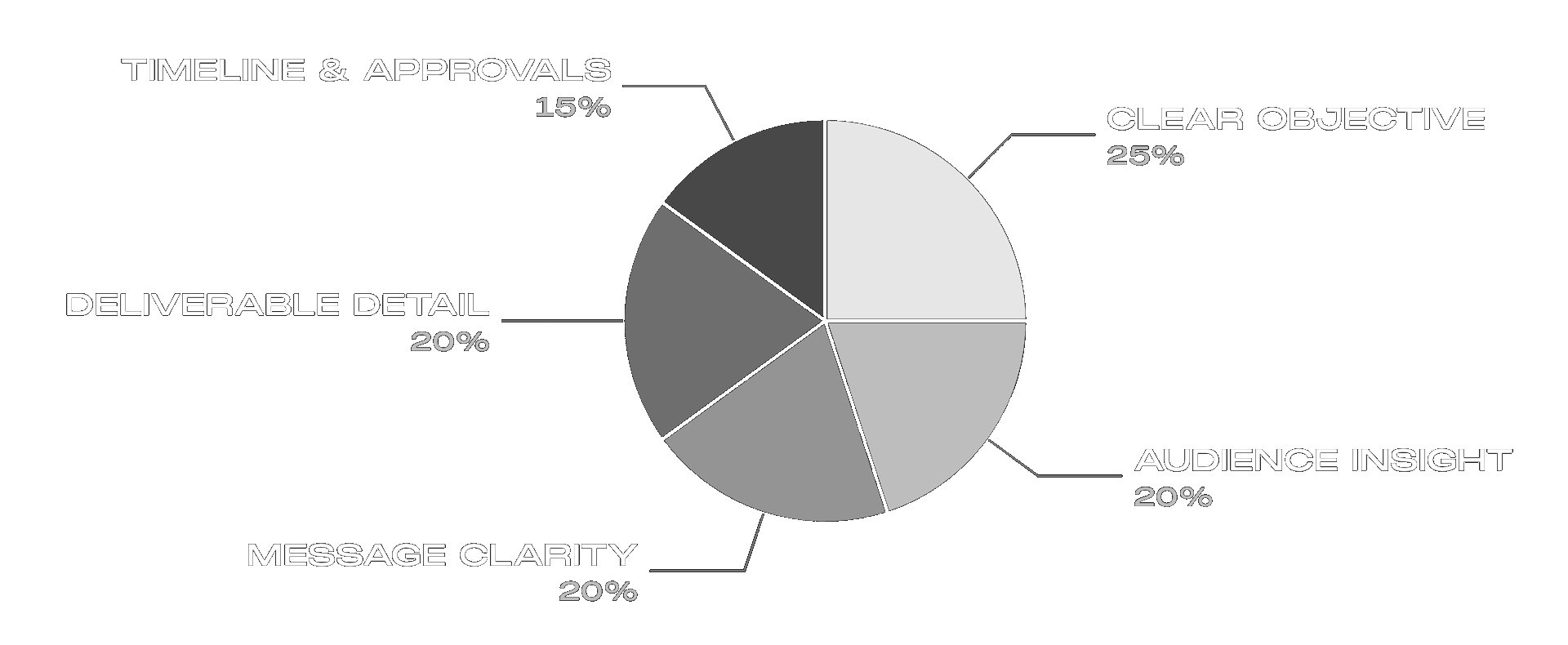
The takeaway: the best briefs balance strategy and logistics. They explain what the video needs to achieve and what the production team needs to plan.
If you are briefing a video team, your job is not to write the whole creative concept. Your job is to give the production house enough strategic and practical information to build the right concept.
Before sending the brief, check that you have the essentials below. If you are still comparing vendors, Emergent’s guide on questions to ask a production company can help you evaluate the right partner.
A strong brief saves time, reduces confusion, and gives the production team room to do better creative work.
A video production brief is a document that explains the goal, audience, message, deliverables, timeline, budget, references, and approval process for a video project. It helps the production team understand what the video needs to achieve and how to plan the creative and logistical approach.
A video production brief should be long enough to give clear direction but short enough to be useful. For most marketing videos, 2 to 5 pages is enough if the brief includes the objective, audience, message, deliverables, timeline, budget, and references.
Yes. Including a budget range helps the production house recommend a realistic approach. Without a budget, the team may propose a concept that is too large, too small, or misaligned with the project’s expectations.
Yes, reference videos are very useful. They help the production team understand the visual style, tone, pacing, and quality level you have in mind. You can also include examples you dislike to show what should be avoided.
The final video brief should be approved by the person who has authority over the project’s objective, budget, and final sign-off. Ideally, one main stakeholder should collect feedback from the wider team and send consolidated notes to the production house.
Planning a campaign, corporate video, product launch, or brand film? Send Emergent Films your brief, even if it is still rough. The team can help shape your idea, clarify the production plan, and turn it into an effective audio-visual story. Contact hello@emergentfilms.com to start the conversation.
The rich text element allows you to create and format headings, paragraphs, blockquotes, images, and video all in one place instead of having to add and format them individually. Just double-click and easily create content.
A rich text element can be used with static or dynamic content. For static content, just drop it into any page and begin editing. For dynamic content, add a rich text field to any collection and then connect a rich text element to that field in the settings panel. Voila!
Headings, paragraphs, blockquotes, figures, images, and figure captions can all be styled after a class is added to the rich text element using the "When inside of" nested selector system.